How We Help
When the team that builds the system isn't the same as the one using it, it's easy to see why each dashboard tells a different story. Eighty percent of software architectures have the same requirements and data sources. The last 20% decides whether you get actions you take every day or reports you look at once a month. We work across all business units, bringing them together from the system build to execution.
Revenue Systems Architecture
Gaps between marketing, IT, finance, and creative don't just cost your company money. They cost you the opportunity to accelerate pipeline and reach more of the market. Revenue systems architecture closes those gaps: one pipeline from your data sources to the decisions your team makes, built so the people reading the numbers and the people acting on them work from the same system.
We have built these for businesses from new startups to the Fortune 15, and we demonstrate ROI before each build. Everything is scoped up front, and the systems are portable. You are never locked to a single model, platform, or vendor.
Engagements: Digital Realty · Equinix
Marketing Attribution & Measurement
Even with industry best-practice tools, attribution can still assign credit to the wrong channels or creative. That creates distraction: teams optimizing each channel in isolation instead of the continuous series of messages that move a prospect from “what is this?” to “I can't live without this.”
We don't stop at measuring the channel level, but look deeper at the creative, and the common features across creative at each step of the customer journey, to see what helps and what hurts, rather than just what a pixel takes credit for. Controlled experiments and holdouts, built outside platforms that are incentivized to overreport performance, so that your budget follows what moves revenue and profitability. It's the same method behind the results we cite here on our website.
Engagements: USCCA · Potbelly
Qualitative Research & Insights
The numbers tell you what happened. Qualitative research tells you what is happening now, and what is about to happen, before it shows up in the stats. Forecasts built only on internal data and platform data mean attaching a goal to last year's outcomes. Tracking external forces gives your team the tools to build a conservative forecast, and to know where to spend time and budget to accomplish your most aggressive objectives.
Reading those signals in real time, and weighing each factor with machine learning across seven hundred tests, is how one client's customer acquisition cost went from $52 to $13.50 in a matter of weeks. We build this as a practice inside your company: interviews, review mining, community listening, and the feedback loops that put customer language directly into your product, offers, and creative.
Engagements: Old School Labs
Strategy & Turnarounds
Before anything gets built, we evaluate what impact it will have on profit, or on your team's ability to generate more revenue. That evaluation is how we sequence engagements: the quickest path to the next ROI, proven, then the next.
It is also how turnarounds start, since most of them begin with initiatives that had the right intent but weren't designed to work together. We help teams move fluidly across channel barriers to function as a single system for revenue, and help train your team to look for profitable opportunities, not just the quick wins.
Engagements: Potbelly · MrCool · Old School Labs
Paid Media & Growth
In a perfect world, you would not need ads to grow your business. But product-led growth and customer advocacy are something you build toward, and while you do, reaching customers gets harder and raising awareness is not enough. Even when you are showing people who you are as a brand, the goal is to persuade them to try, to buy, or to learn more. Each of those requires different metrics, different creative, and a strategy for measuring the impact, so the experience stays fluid for the customer and every step moves them forward.
It is not as simple as doing what the platforms tell you to do. Their incentive is to get you to spend more whether or not it produces results, which is why we do not take a percentage of spend. You can embed us with your team, or take fixed-scope, fixed-bid implementations over a six-to-twelve-week sprint. We are platform agnostic, and we design customer journeys across paid media, email, and other owned media, so you don't have to focus on which channel gets the credit, and can instead focus on which system is the most optimized for generating customers who buy, stay, and continue to buy.
Engagements: MrCool · Potbelly · Skull Shaver · Transparent Labs · Old School Labs
Experience Design & Content
Content should always have a financial objective. There's no reason to split branding and selling, and you should avoid anyone who tells you their goal is to “raise awareness.” We build on the formulas from Eugene Schwartz, tailoring the customer journey to their needs and their perspective, while echoing the sentiment of David Ogilvy: “We sell or else.”
If it isn't backed by data within the target market, it doesn't end up in scripts or ad creative. We test small and prove before we invest in anchor content.
Engagements: MrCool · Potbelly · Skull Shaver · Transparent Labs · Old School Labs
What we typically find
Even well-run operations have opportunities:
Vendor and initiative overlap
Two or more vendors, tools, or internal teams covering the same ground, each with a defensible reason for existing and no shared view of the total cost.
Unattributed or over-attributed conversions
Revenue credited to the last touch, or to a channel that reached demand which already existed. The platform number and the booked number describe different events.
Committed spend with unreviewed exit terms
Retainers and licenses that renewed on the original assumptions, where the exit clause has not been read against current usage.
Metrics that mean different things by department
CAC, qualified lead, and payback defined one way in marketing and another in finance, so the same report supports two conclusions.
We work in your stack, not ours
We do not resell a platform, so we have no reason to steer you toward one. Work happens in whatever cloud, warehouse, reporting, CRM, measurement, media, and AI layer you already run.

























Start here, it’s free.
Find where you’re overspending in your business. Find out how much.
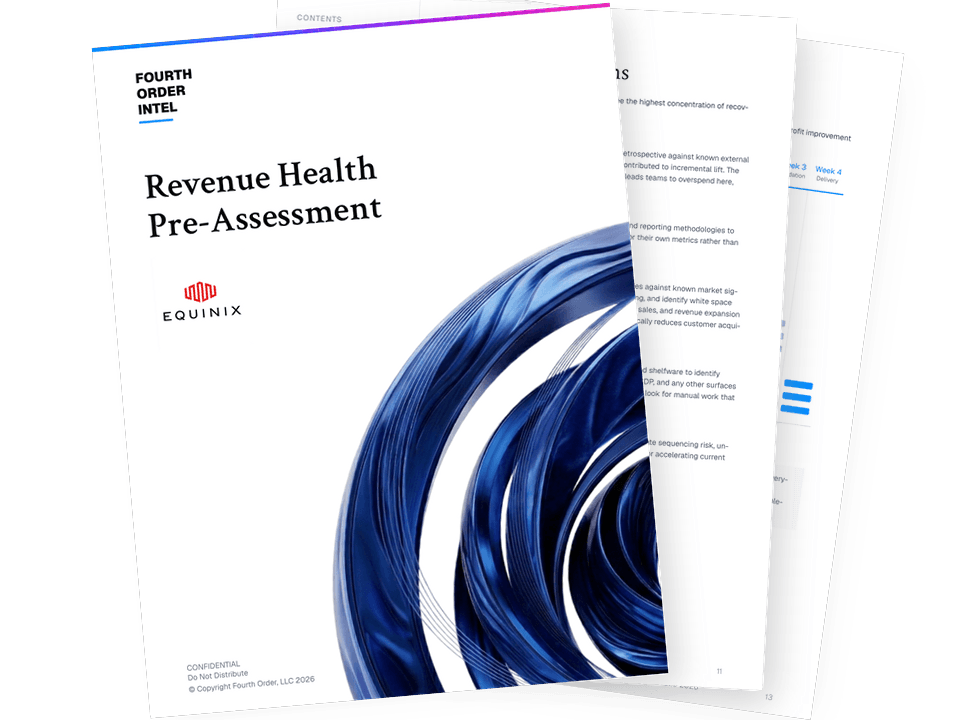
Answer twelve questions. Our team reviews your site, your ads, and your tech stack and returns a dollar-denominated estimate of recoverable waste across your business.
We evaluate these four common failure points:
- Advertising & Media Efficiency
- Go-to-Market Strategy
- Technology & Measurement
- People & Team Alignment
Confidential · Reviewed by our team